Archive for January, 2008

h1

Day at the Embassy

January 10, 2008

Tom – Took a taxi to the US Embassy for our security briefing.  The senior security official was emphatic; we are not permitted to go to the north or east of the island.  The government is attacking the LTTE in the north and they are responding with terrorist attacks in Colombo and elsewhere.  Foreigners have so far not been targeted.  I was surprised to hear that the individuals most at risk from the LTTE are the Sri Lankan aid workers, whether sponsored by government, private, or religious organizations – many have been killed throughout the country.  Had our photos taken for our embassy IDs, learned about our commissary privileges, and then walked to the Fulbright office with the Fulbrighter and family who will be in the engineering faculty at the University of Ruhuna campus in Galle.


We spent the afternoon at the Fulbright office working on organizational matters and using the computer.  Chitra drove us back to the guesthouse and explained how she swims each Sunday and that Helen would be able to join her at the swim club whenever she liked.  Mohan (Daveka’s father) called and invited us to the Ceylon Motor Yacht Club on Sunday.  He and his wife Ayomi came over shortly thereafter to give us written directions in English and Sinhalese to direct a taxi driver to the Club.   


While they were there, Rohana arrived to take us to dinner.  There were greetings around and we then left for the Royal Colombo Golf Club.  It was great reconnecting, having a couple of drinks, and then a wonderful fish dinner with Rohana.          

h1

The Opera

January 9, 2008

 TomRuki called a taxi for us and we were at the Fulbright Commission office about 9am (250 rupees or $2.34).  We met the staff – Soraya the Secretary, Ramya the Program Officer, Chitra the Accountant, and Nelum the Student Advisor.  A driver then took us to open a savings account with ATM card at the Hatton National Bank.  Also stopped at a bookstore to get a detailed book of maps of Colombo and Helen bought a Sri Lankan cook book.


Did some email at the Fulbright office and then walked to Odels which is a mini shopping center.  Ate a DeliFrench roast chicken sandwich and then went to Dialog to buy two cell phones, cell phone service and a $10 Kit card for each phone.  Total cost about $91.  You scratch the back of your Kit card to get your number then phone Dialog to record the amount.  You can call the phone company any time to hear how many rupees you have left.  The rates are great; 0.10/min in country, 0.15/min to the U.S., and .05/min phone to phone.  On our walk back to the Fulbright office we bought a cut up mango on the street.  Actually it’s recommended you not eat cut fruit, you’re supposed to buy it and cut it yourself to guard against bacteria. 


Helen sat in on my meeting with Tissa the Fulbright Executive Director.  We reviewed the history and problems I had during the application and selection process.  We agreed that Helen and I would drive to Matara and the University of Ruhuna on Friday to determine if I could have a meaningful assignment there.  We also discussed the possibility of working at two or three different universities.


When we arrived back at the guesthouse we found that Ruki was preparing to go to the Opera with one of her daughters.  She called and found that tickets were still available.  So, we changed immediately and rode a Tuk-Tuk (100 rupees/little less than $1) to Bandaranaike Memorial Hall.  If you get a Tuk-Tuk from your neighborhood, they pretty much know you and you get a fair price.  We bought the cheap seats ($15 each) in the nose bleed section in the very top row.  We saw “The Pearl Fishers,” with the setting in Sri Lanka sung in French with English subtitles by Georges Bizet (1863).  It was performed by an Indian company and they were excellent!  This is the same composer as Carmen with the familiar love triangle   Think of it, an Opera in the chaos of Sri Lanka – incongruous but enjoyable.  Afterward, we tried to take a Tuk-Tuk back but the minimum we could get the drivers down to was 200 rupees, ticked-off, we walked the mile back.  Irene had dinner ready for us (10pm) and then we went to bed.       

h1

Colombo

January 8, 2008

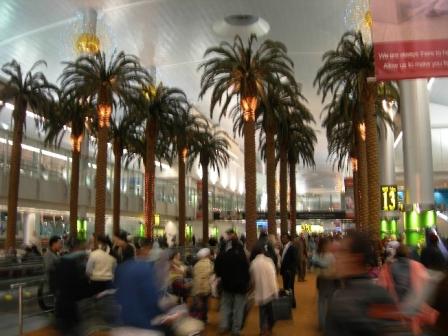
 TomArrived in Dubai at 12:30am.  It was as though we were there during rush hour – it was packed!  Dubai is the fastest growing city in the world.  The airport is big and new but many parts are still under construction.  We passed full size fake palm trees, big screen HD TVs everywhere, men’s mosque, women’s mosque, world food (of course Starbucks), myriad of duty free shops, fountains, musicians, etc.  But most interesting were the appearances and dress of people from all over the world, especially the Mideast and East.  Our flight left one hour late at 3:30am.  For the first half hour I could look down into the Persian Gulf and see multiple small islands covered with lights (oil facilities). 


Another night of little or no sleep, there was also an additional 3.5 hours lost (making the time difference to Ohio 10.5 hours) as we flew over the Indian Ocean.  We stopped for about an hour at the Male (Maldives) airport and arrived in Colombo at 11:30am.  I bought our maximum liquor allocation at the duty free store but that turned out to be a mistake because I found out we have commissary privileges (for $20) at the U.S. Embassy.  Our Fulbright taxi driver named Fernando was at baggage claim to greet us and take us by van into Colombo to our guesthouse.  It took us over an hour and a half because of a detour around a section of the main highway due to a terrorist bomb explosion that had just killed a government minister.


First impression of Colombo? – we were tired so nothing looked good.  Poverty, dirt, garbage is everywhere.  Traffic was like being back in Iran, really it is worse!!  Two lanes marked on the road meant at least three rows of cars going in the same direction sharing the road with dogs, cows, people, jaywalkers, bikes, motorcycles, and a new dimension – the Tri-Shaw or three-wheel motorcycle taxi that they call a Tuk-Tuk.  Everyone is weaving in and out and the center lanes play a game of “chicken,” passing into oncoming traffic until they squeeze back into their own lanes.


Irene the maid, the boy (around 70) and Ruki the owner met us at the guesthouse.  This is a big old house in what is considered an expensive area of Colombo.  We moved into our room and then were given tea in the TV room after which we laid down for a rest.  Our room is on the second floor with a bathroom right next to it and the TV room across the hall.  The hall attaches to the dining room and living room followed by a kitchen and a back second floor patio.  Ruki’s large bedroom is off the living room.  Rohana had called while we were resting.  We served as his host family when he was a student at Wittenberg.  He graduated in 1991.  I had sent a letter to his last known address and I was amazed that he had received it!  He is now 41, single, and still living with his parents but is in the process of building his own home.  He runs the procurement department for the United Nations Development Program in Sri Lanka.


It was a big day and we went to bed early.        

h1

Orthodox Christmas

January 7, 2008

 TomSlept late, had the buffet breakfast and while Helen packed I worked on the computer.  I broke down and paid $28 for 24 hours of internet use in our room, even though we were leaving at 3:45pm.  Picked up the two large suitcases we had checked with the hotel when we arrived and headed for the airport.  Our Travco people again accompanied us and helped us all the way to the gate.  Our Emirates flight to Dubai left Cairo at 7:15pm.

h1

Kom Ombo and Aswan

January 6, 2008

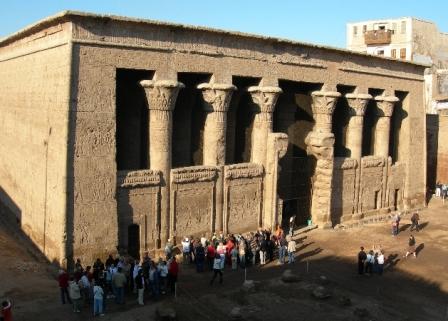
Tom – We docked at Kom Ombo during the night and were up early to start our guided tour (Anmor) of the Kom Ombo Temple at 7:30am.  It was a magnificent site to see out of our cabin window that morning.  We wondered how we would be able to see anything in the short time allotted but found that we were only a short walk away.  Kom Ombo means the crocodile god.  It seems that the Nile River was infested with these beasts and they were known to eat the animals, people, and children that lived along the shore.  They thought that if they worshipped a god dedicated to the crocodile it would be nicer to them; but how do you worship an evil thing??  So they divided the worship between two gods, the good god Horace (the falcon) and the bad god Kom the crocodile.  The first site we saw was a small room with three mummified crocodiles; good size but nothing to compare to the ones in the Cairo Museum.

Temples were important for various reasons: worship, gathering place, school, and for healing.  This temple was the first to show the medical wall depicting the instruments used, such as hooks (the brain was taken from the head through the nose by a hook when mummifying, ugh), spoons, knife, saw, medicine bag to hold the herbs, and a balance scale to weigh the herbs.  To the side of the instruments were the birthing stools with women sitting on them ready to deliver.  On another wall you actually saw a delivery with the child head down from the waist with arms outstretched over head coming from the mother.  There were several other reliefs that showed mothers nursing their babies and one that showed a two year old child nursing as well. There was also a baptismal font and an arrangement resembling a confessional with the priest in the middle and two alcoves on either side.

Since the temple was so close to the river, it also had a “Nileometer” which was a huge/deep well that measured the height of the Nile flood and therefore predicted the value of the next harvest.  The depth of the Nile was determined by the number of stone blocks covered by the water.  Another interesting wall represented the calendar.  Their year had three seasons (flood, sowing, and harvest), each season had four months, each month had three weeks, each week had ten days adding to a total of 360 days.  There were five additional festival days for the primary gods (365) and each year had ¼ day added so that the fourth year they had a day to celebrate their village god.  Pretty good for 4,000 years ago!

dscn1097.jpg

dscn1101.jpg

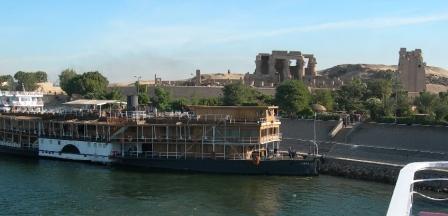
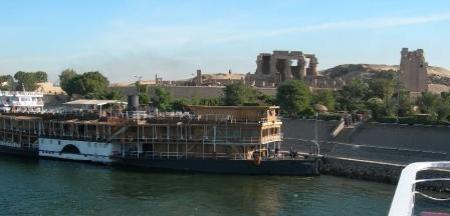
This is a picture of an older river tour boat as we left Kom Ombo
dscn1106.jpg

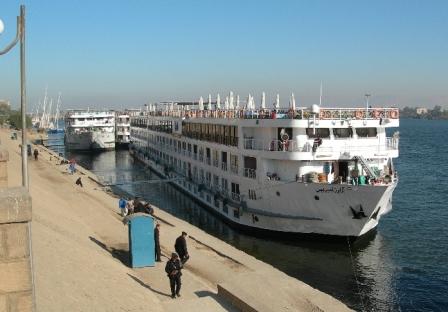
I did a tour of our boat, the Crown Empress, this morning.  It is the largest of 282 cruise boats on the Nile River.  It is 110 meters long, 50 meters wide, has a draft of 1.5 meters and has four stories of rooms.  As mentioned previously, the entire top of the boat is the deck.  They call it the “train.”  It can accommodate 270 passengers; however, we have about 150 on this cruise.  The eating area is on the bottom level and you are actually sitting below water level – it is an interesting perspective as you look out the large windows.  The boat has three 500 hp engines and an immaculate kitchen with several preparation rooms.  One was for breads and pastries, one for meat, and one for vegetables and salads.  In the preparation room all produce is disinfected and only bottled water is used in washing and preparation of food and sauces.  The captain in the control room has all the latest technology at hand but we were told he doesn’t use it; he just sails by knowledge and instincts.  We were told that the captain or pilot positions are family affairs and passed down from father to son.

As the boat cruised upriver toward Aswan, we went up on deck to enjoy the scenery, a cup of coffee, and learn how to play cribbage.  Kristi brought up her game, told us the rules, and then Helen and I played our first game – Helen won by a couple of points.  As we ate lunch the boat docked in Aswan and we prepared for our tour starting at 11:30am.  In preparing to take the tour, I examined my materials from the travel company and discovered that they were not consistent.  We were supposed to get a four night cruise and when they rescheduled our return flight from Aswan, when we arrived in Cairo, they gave us only 3 nights on the boat – that meant that we had to be back at the boat by 4pm in order to catch our flight back to Cairo and that we would miss the Nubian night dinner and entertainment!

We were not happy but needed to get over it so we could enjoy the afternoon.  Anmor was again our guide but this time Curt and Kristi accompanied us because they had refused to go with their original guide who had “blown them off” in Edfu.  Because there were now five of us we had a Travco van and driver.  Our first stop was the Western Quarry that had been used to acquire the stone for many of the monuments and pyramids we had already seen.  The technique for extracting the large blocks of granite and their movement to the river for transport was fascinating; everything was done by hand using basic physics and gravity.  Holes were chiseled and then wooden wedges were placed in them and soaked with water.  As the wedges expanded they would crack the granite along predetermined lines.  The blocks would then be rolled down to the Nile on logs when the river was in flood stage and transported by boat downstream.  They also cut large obelisks (hundreds of tons!) from this quarry and we could see one that was three-quarters finished that was found to have a flaw and therefore never completed.

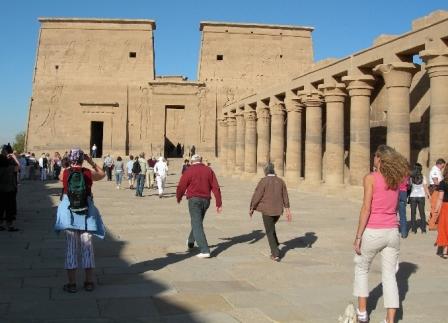
Next we drove to and across the low Aswan Dam built by the British (1898-1902) and then up to the high Aswan Dam built by the Soviets (1960-1971) for a view of Lake Naser and the Nile River Valley.  Many Egyptian monuments and historical sites were flooded with the formation of the dams.  We visited one of these, Philae and its temples which were saved by UNESCO.  They built a waterproof wall entirely around the island, pumped out the water, and then cut and removed the structures block by block and rebuilt the structures as close to their original configuration as possible on a nearby island that is twenty meters higher in elevation.  The project cost 40 million dollars!

We got to the island by taking a Nubian launch to its south side.  I took some great pictures during the ride.  Most of the structures were related to the Temple of Isis and dated from about 380 BC to about 305 AD (almost 700 years!).  The early Christians then defaced most of the reliefs and inscriptions even forming a church inside the temple.  Then the Muslims defaced the Christian facilities!

dscn1122.jpg

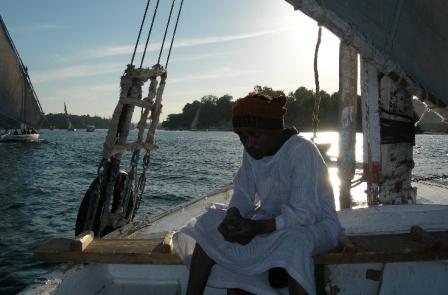
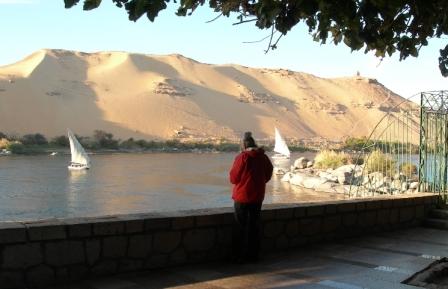
Driving back to Aswan, we stopped near our boat to take a Felucca (sailboat) to the Aswan Botanical Gardens on an island in the Nile River.  Feluccas are large wooden catboats with a large cotton sail.  The captain stands on the stern and controls the large tiller with his feet as he uses a pulley system to control the sail.  There is also at least one crewman (we had two) who can help with trimming the sail and raising and lowering the centerboard.  Our crew of three were all young Nubians.  Nubians are quite black and we were told that they have a tightly knit community not allowing intermarriages.  They have often revolted against the Egyptian authority.

The Botanical Garden was completed by Lord Kitchener in 1928 when he was consul general of Egypt and commander of the Egyptian army.  He imported plants from the Far East, India, and parts of Africa.  It is a beautiful place juxtaposed to the backdrop of the western edge of the Sahara desert on the west side of the Nile.  Helen bought a small hand made wooden camel from one of the young Nubians as we sailed back to our boat.
dscn1135.jpg

dscn1139.jpg 

Long story short, we caught the 8pm Egypt Air flight to Cairo and were transported (hour and a half) to our original hotel on the west side.  As we drove through the city we saw a Coptic cathedral completely covered with lights for Orthodox Christmas Eve.  Had we known we would have been here, we would have planned to go to mass.  Stopped to buy some KFC for dinner on the way, and hit the sack about midnight.

h1

Esna, Edfu and Fish Like an Egyptian

January 5, 2008

Tom – When we woke for breakfast we found that during the night our boat had moved through the lock and was now docked at Esna.  When we left for the tour of the Esna Temple we were surprised that our guide was again Sarah.  She had driven the 34 miles from Luxor with the other guides.  It was again a clear day (except for the haze from burning sugarcane) with a cool breeze.  We walked about two blocks to the temple moving through the main tourist alley lined with stalls.

The Graeco-Roman Temple of Khnum (Ram headed creator god) is the main attraction of Esna.  Only the Hypostyle Hall of the temple has been excavated so far.  The rest is still under sand and the houses that have been built on top.  They have the same problem here as we have in Springfield, that is, people don’t want to give up their homes for a community project.

The temple has some great reliefs that show the Greek and Roman emperors or Kings making offerings to the Egyptian gods.  We were told that the Greek and Roman occupations of Egypt were so successful because they accepted and incorporated the Egyptian gods into their own religious ceremonies.  After visiting the temple, we haggled to purchase two galabia ($17), light robes worn by the Arabs, for the galabia party on the boat that night.

dscn1067.jpg

dscn1069.jpg

The boat continued up the Nile (south) as we ate lunch and watched the river bank from our room and on deck. 

dscn1071.jpg

dscn1076.jpg

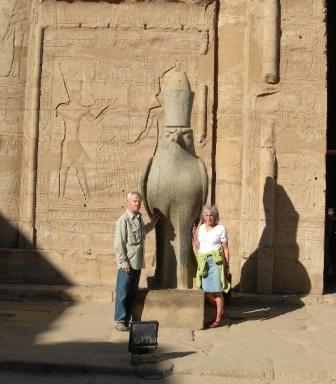
 In the afternoon we stopped at Edfu where we met our new guide Anmor, a teacher from Aswan.  We rode a decorated horse drawn carriage to the temple.  The Temple of Horus is another Graeco-Roman temple and is the most completely preserved temple in Egypt.  Horus is the falcon god and the son of Isis.  We enjoyed hearing the mythology stories from our guide and seeing the events depicted as reliefs or engravings on the stone walls.  The Graeco-Roman temples are constructed as pyramids lying on their side.  Therefore, as you walk down the central axis, the structures (columns, walls, etc.) get smaller and smaller until you reach the holy of holies, where the gold statue of Horus was once located.  It is as if you are looking down a rectangular tunnel.

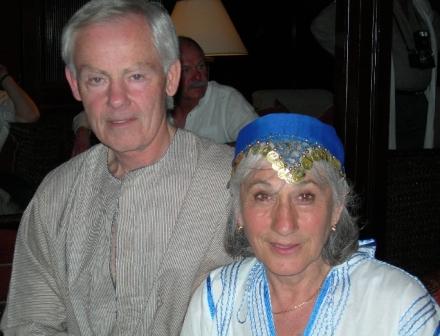
On the way out of the temple, after much haggling, Helen bought a blue veil with coins to wear at the galabia party that night ($4).  We both felt a lot of tension in town during our carriage rides back and forth and were glad to get back to the boat.  The other two couples who sat at our table both had troubles with there guides.  One left them at the temple and never returned and the other got out of the carriage half way back to the boat and had them pay the fare!

dscn1078.jpg

dscn1081.jpg

Today Helen learned how to fish the Egyptian way!!  In a row boat with unusual oars (long planks counterbalanced near the handles), one man rowed and the other stood and slapped the water with a huge palm branch.  He was scaring the fish into a net set in the water ahead of the boat.  When they could tell they had enough fish by the depth of the float attached to the net, they would pull it in and start again.

Another observation from the deck was the difference between the two shores.  On one side the ground is level and very green, the other side, is more hilly and brown with the desert sand.  As you look at the brown background you notice several homes; most of the them are the same color as the desert and shining through you see some painted a lovely blue, sometimes pink, or yellow.  It is amazing to think that the Sahara desert goes from the west side of the Nile to Morocco covering an area bigger than the U.S.

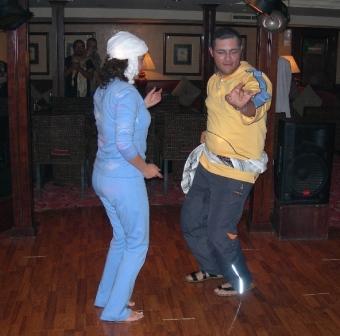
It was Egyptian night on the boat.  The buffet highlighted Egyptian food and most people dressed in some semblance of Arab attire.  Our newly wed table mates Rafaei and Amna were corralled by singing/drumming boat workers and performed a traditional Egyptian wedding dance.  There was a raffle drawing that night in the lounge and dancing until about 11pm.

dscn1089.jpg

dscn1090.jpg


h1

Valley of the Kings and Scarves

January 4, 2008

 Tom – We took breakfast early (5:45am) in order to be ready for our tour that started at 6:30.  Sarah again met us in the lobby and we drove to the West side of the Nile, past the Colossi of Memnon (about 60 feet high but very eroded), and to the Valley of the Kings.  Our tour ticket allowed us to go in 3 of 11 possible tombs.  There are 62 known tombs in the valley.  Sarah selected three for us and they included the tombs of Ramses IV, Merneptah, and Ramses I.

   Ramses IV  Walking down the tunnels into each tomb was exciting, there was always something else to see.  You could spend a day in each trying to decipher the meaning of the figures and hieroglyphics.  The painting and color on some were still quite good, however on most it was either faded or non-existent just showing the symbols.  The red granite sarcophagus of this tomb is one of the largest in the valley.  This tomb is also known for the striking painting of the goddess Nut stretched across the blue ceiling.

Merneptah  He was the 13th son of Ramses II, who was the most notable pharaoh having ruled Egypt for 67 years.  Merneptah’s 12 older brothers died before Ramses II.  This was a long tunnel like tomb with fairly well preserved reliefs.  We especially liked the blue ceiling with gold stars

Ramses I  There was a short but steep walk down into the tomb of Ramses I.  Only the burial chamber was decorated and included many scenes of the pharaoh with various gods including one where the pharaoh is knelling between the jackal-headed “Soul of Nekhen” and the falcon-headed “Soul of Pe” representing Upper and Lower Egypt.

Tutankhamun  We also paid an extra 160 Egyptian Pounds ($29) to go in the tomb of Tutankhamun (boy pharaoh – 18), which was the only tomb ever found nearly intact (1922).  The majority of the treasures found in the tomb are on display in the Egyptian Museum in Cairo.  Some go on world tour and the only ones currently in the tomb are the outermost of three gilded wooden coffins, setting in a red quartzite sarcophagus, and the mummy showing only the head and feet.

dscn1042.jpg

dscn1044.jpg

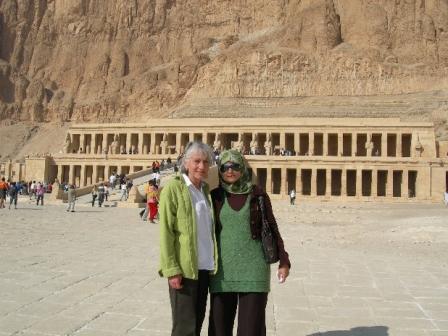
After leaving the Valley of the Kings, we stopped at a stone shop where they demonstrated the hand making of alabaster jars.  Again, we were lead to the showroom and pressured to buy something.  Continuing, we went to Deir al-Bahri and the large and impressive Temple of Hatshepsut.  Unlike the majority of visitors, and to the surprise of our guide, we wanted to walk about a third of a mile from the entrance to the temple and not use the trams.  It was set up on a direct line from the Temple of Luxor across the Nile.  Hatshepsut was a queen who acted as pharaoh for 15 years when her husband died and was obviously very powerful.  She is shown in some reliefs dressed as a male pharaoh (including a false beard) and in others as a female.

Made it back to the boat at departure time and found that we now had to walk through four boats to get to ours, which had been moved from the dock to the outside of the other four boats.  We went up on deck to watch departure and the start of our cruise.  The deck consisted of the whole top of the boat including a covered bar, what they called a pool (wading pool with a deep 4 x 15 foot end for submerging your body), about 170 lounge chairs, 180 other chairs around about 50 tables, 18 large umbrellas, two old exercise cycles, and one tiny treadmill.

Ate lunch, went back to our cabin and opened our curtain and large sliding door.  I worked on this diary while Helen either knitted or read.  We would stop regularly to watch Egypt go by – palm trees, banana groves, small villages, birds, sugar cane fields, fisherman, domestic animals, and in the background the barren landscape.  Putting it simply, it was green by the river and brown in the distance.

dscn1052.jpg

At 4:30 we went for tea time (coffee) and more Egypt watching on deck.  When our boat stopped to queue up for the lock as Esna, small rowboats descended on all the cruise boats.  As one man controlled the boat, the other would call out in multiple languages to the tourists on board and throw plastic bags with cotton scarves (also towels) on to the deck.  Then there would be negotiations back and forth with plastic bags flying everywhere.  Only a few tourists INCLUDING Helen participated in the exchange and most bags were just pitched back into the boats or water where they would be fished out.  Rafaei also participated and, since we didn’t have any Egyptian pounds, eventually paid 100 pounds (about $18) for two, one for Helen and one for Amna.  Afterward we had dinner and then our group played Tablet in the no smoking area of the lobby until bed time.

dscn1058.jpg

dscn1059.jpg

h1

Luxor

January 3, 2008

Tom – Didn’t sleep well, luckily we had packed the night before so only had to dress and go.  Karim and Wahil were on time and Karim brought us kufte kebob sandwiches that his mother had made and mango juice drinks for breakfast.  We checked our two large suitcases at the hotel for our return and paid our bill.  They charged us for our New Year’s Eve Gala, which I had already paid for, so that had to come off the bill.  Then I found that they charged me $2 a minute for the calls I made ($80) – I thought they were covered by my phone card!

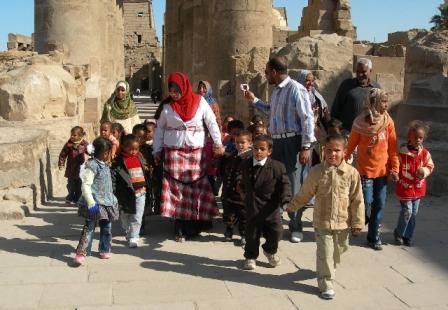
Our Egypt Air flight to Luxor left at 6am.  It was less than an hour flight and we were at the Crown Empress Nile cruise boat by 8am.  We met Sarah our personal guide in the lobby and immediately were off with our own driver to the Temples of Karnak.   I could get use to this kind of treatment!  It would take a book to describe this place.  First it is big – about one mile long and half a mile wide.  Second, it has been built, re-built, expanded, destroyed and reconstructed many times over 1500 years.  Third, it contains numerous temples, sanctuaries, pylons, obelisks, chapels, statues, and a sacred lake.

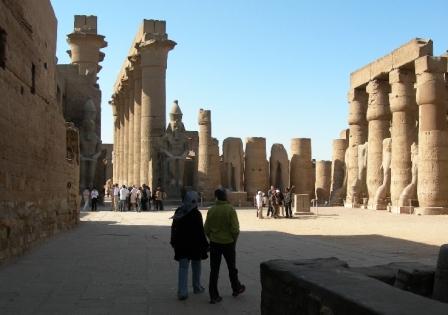
Connected to Karnak to the south is the Luxor Temple two miles away.  Luxor was also known as Thebes.  Though smaller and right in the middle of town, it is as impressive.  Like Karnak it has changed significantly through the years.  There was a relief of Alexander the Great representing himself in Egyptian regalia in his role as pharaoh.  There was even a mosque built on top of some of the ruins and the remnants of a church that was built after a Roman Fort there was burned.  History on top of history, how do you keep it all straight?

dscn1023.jpg

dscn1025.jpg

dscn1029.jpg

We were back at the boat for lunch and to check into our room at 1pm.  The room was bigger than I expected with two single beds that we pushed together, a desk, two comfortable chairs with end table, a large closet with shelves, and a good size and modern bathroom.  There were two large double doors that could be opened for an open air view of the river and it was fun watching the riverbank and scenery as we passed.  We were on the top level (fourth floor) so we could see well over the river bank.

We were tired from the early morning start and dosed a bit until tea time (4:30 – 5:30).  Tea/coffee, light snacks were offered each afternoon on deck.  Though sunny the breeze was cool and we needed jackets to be comfortable.  We sat at table 12 for each meal.  There were two other couples at our table, Rafaei (24) & Amna (22) newly weds from Alexandria.  Rafaei works in Dubai.  He was a national caliber distance swimmer and is also a sailor.  Curt (51) & Kristy (  ), also newly weds (second marriage for each) were from Hawaii (Maui).  Curt is a contractor and former freestyle skier and Kristy is a part-time surgical nurse.

After dinner Helen and I walked downtown to see Luxor Temple at night.  It was interesting to also see some Christmas decorations, lights and even Santa Claus and a reindeer.  Our boat was parked right across from King Farouk’s winter palace which is now a hotel.

h1

The Pyramids

January 2, 2008

Tom – Got in the car at 8:30am and were taken for a full day of Pyramid tours.  Aziz twisted his ankle getting in the car after dinner yesterday and was unable to act as our guide so we were given Mohamed, one of his sons from his first wife.  It seems Aziz has four wives.  Number one wife has three children with Mohamed being the youngest (27).  Number two wife has four children.  Number three wife has two children.  Number four wife does not (yet) have any children but Mohamed said that he is working on it.  We were told that Aziz spends one night a week with each wife and uses the other three days to recharge his batteries.

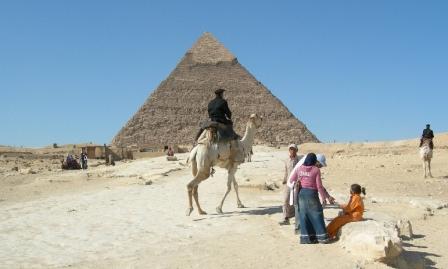
We started at the Giza Pyramids – the sole survivor of the Seven Wonders of the World.  The complex at the edge of Cairo is dated about 2000 BC.  Like everyone else, we had learned about these pyramids and seen pictures and movies throughout our lives.  However, considering their age and seeing their size and the intricacy (workmanship) of the massive enterprise, we were indeed impressed.  We were able to buy two of the 150 tickets ($20 each) that allow you to go inside The Great Pyramid of Khufu (Cheops) in the morning.   You climb up stairs cut into the bottom six layers of limestone block and then enter a tunnel that goes about one third toward the center of the pyramid.  Then you go up a shaft by way of a steep incline (45o) about 4 feet high until you reach the burial chamber where the sarcophagus still remains.  Just before we entered the shaft, we waited for 40 Asians to come down.  They were huffing and puffing and perspiring from so many being in the shaft at the same time, hunched over to keep from hitting their heads.  Thus we were able to go up and down quickly before the next group came.

We then drove to a nice overlook of all three pyramids.  Many people were negotiating horse, donkey or camel rides.  Everyone was being hassled for “baksheesh” (handouts) or to buy some trinket.  We decided to walk around the perimeter of the second pyramid (Pyramid of Khafre – Khufu’s son) and marveled at the top which seemed to have no support as the rocks under it were gone.  There we saw a lady getting off a camel and then being asked to pay-up.  She gave him something but he clearly didn’t think that it was sufficient and kept at her as she tried to get more money out of her hip pack.  Finally her husband, a fairly large man, intervened and the driver still kept after them.  I guess that there is one fee to get on and ride the camel and then another fee to get off!!!   There was also an enclosed building behind the first pyramid that protected one of the large wooden funeral boats.  The third and smallest pyramid was the Pyramid of Menkaure – Khafre’s son.

There was a long causeway that led up to Khafre’s Funerary Temple at the base of his pyramid.  At the bottom was the famous Sphinx (appearing smaller than expected), the winged monster with a woman’s head and lion’s body who set riddles and killed anyone unable to answer them; thus protecting the pyramids.

dscn09891.jpg

dscn0992.jpg

The Step Pyramid (Pyramid of Saqqara) is about 13 miles south of the Giza Pyramids and is older (2650 BC).  It was built by Zoser and is Egypt’s and the world’s earliest stone monument.  It was built in five layers and, though badly damaged, is still impressive.  Zoser was pretty smart because he had false treasures enclosed in the pyramid (knowing the grave robbers would find them) and had the real treasures buried nearby in two separate vaults (which they were excavating as we watched).

Our next stop was a carpet factory.  We were given a tour and explanation of the carpet making process from the silk worm cocoons, to the threads, to the looms, to the making of the knots, to the finishing touches and borders.  Children were making the fine carpets because of their small fingers.  It was explained to us that they went to school for 4 hours and worked 2 hours each day and that the factory was helping them learn a skill.  We were then brought upstairs to a huge carpet display area with thousands of carpets.  Our carpet guide (a.k.a. salesman) gave us hot tea and proceeded to describe the myriad of carpets available.  What size, design, color, and quality are you interested in?  Of course, just for looking.  Do you like silk, wool, cotton, warp/weft/knots?  Each answer resulted in the viewing of several carpets.  Price? – not to worry, you will get best price, with discount!  Helen asked about different designs and named a few of the examples he showed; he knew then it was not going to be an easy sell.  After pricing several new carpets, Helen noticed the antique ones.  Now the price really skyrocketed.  Even though we knew all along what was coming, it was still hard for Helen to extract herself from the showroom.  One of the tactics is to make you feel guilty for NOT buying something.  We were obviously keeping those poor children in poverty!

Memphis was once the capital of Egypt.  It was founded at the border of the “Upper and Lower Lands of Egypt.”  That is, where the Nile Valley meets the Nile Delta.  There isn’t much left, a small museum built around a large limestone statue of Ramses II that is laying on its back and an outdoor sculpture garden.  There were the usual stalls and hawkers of merchandise surrounding the parking lot and Helen bargained for a bright 2 x 3.5 woven carpet with fish, birds, etc. for $10.

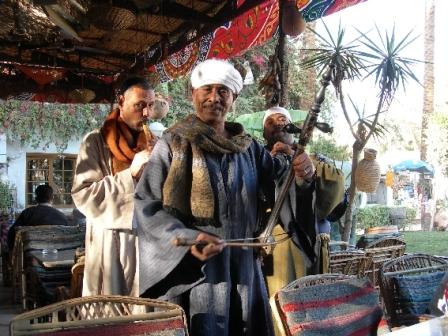
We ate “lunch” around 3pm at an excellent roadside restaurant.  It was an opulent place with camel rides, baby lion to pet, antique cars, traditional Egyptian musicians, and a large display devoted to Egyptian movie stars and the last king of Egypt – King Farouk, who was deposed in 1952.  We had lamb and chicken Kebob (grill on the table to keep them warm) along with about 10 different garnishes.  We insisted that Mohamed and Wahil eat with us and we all had a good time.  Arriving back at the hotel, we were tired and tried to go to sleep early since we had to get up at 3am to get to the airport by 5am.

dscn1005.jpg


h1

First Full Day in Egypt

January 1, 2008

Tom – No football games today!  We had the extensive buffet breakfast that came with our room and were then picked up by Karim, the young man who was in charge of coordinating our trip, and a driver at 8am.  We drove to the Egyptian Museum where we met Aziz, our personal tour guide.  Aziz was a very friendly and knowledgeable older gentleman who knew folks everywhere we went.  He would regularly get interrupted with calls on his cell phone.  We were truly pampered.  Aziz took us in front of the large crowd waiting to get in and we were the first ones to enter the museum when it opened at 9am.

The museum was fascinating with exhibits chronologically from the Old-Kingdom to the Roman Empire.  It’s mind boggling to think that some of these artifacts are from 4600 years ago!  One of the highlights of our tour was the priceless Tutankhamun collection which was unearthed intact in 1922.

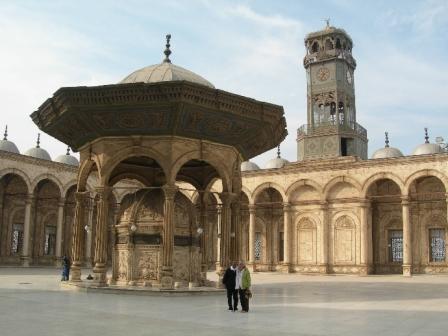
Aziz called the driver before we left at 11:30 and he was waiting for us outside the front gate.  We were whisked to the Citadel, which was built by Saladin in the eleventh century to protect the city from the Crusaders.  It is dominated by the Mosque of Mohammed Ali (no relation to the boxer).  Aziz directed us to take off our shoes and enter.  We sat on the carpet near the front as he explained the five pillars of the Muslim faith and a muezzin sang out noon prayers.

dscn0976.jpg

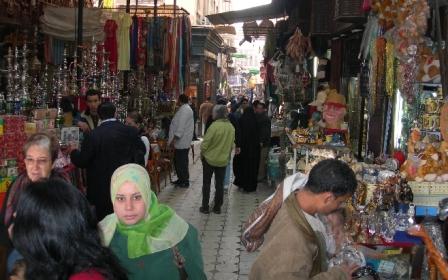
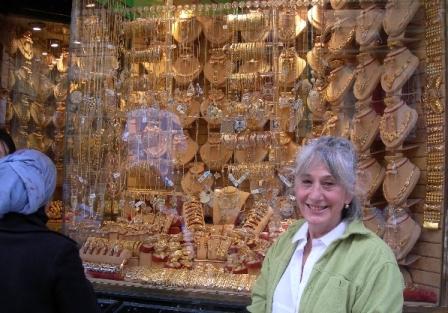
Our driver again met us as we exited the Citadel, next stop the Khan El Khalili Bazaar.  We decided on one hour for us to explore alone.  Though warned by our guide that she would be taken no matter what she bought, Helen was determined to come away with a “deal.”  She examined and priced large scarves at several stalls and then commenced to bargain for four at yet another.  The owner started at about $12 for one scarf.  The two of them went back and forth for 15 minutes and then Helen offered $20 for four.  He said no but when she started to walk away agreed to that price.  Helen was elated!  As we exited down yet another alley of the bazaar, she had to check one more shop that had scarves.  Well, the same scarves were $5 each but the owner would not come down in price.  So, the question is, did Helen get a deal?  The answer, it didn’t matter because she had so much fun and the local observers gave her the thumbs up when the haggling was complete.

dscn0978.jpg

dscn0983.jpg

We met Aziz at a tea/smoking store at the entrance to the bazaar.  We had a cup of sweet mint tea as we watched sunglass hawkers pushing their wares.  How about a genuine Rolex watch for $55?  A pair of Prada sunglasses for $20?  Well, as we left for the car Helen bought those sunglasses for $5.  They look good and it doesn’t bother her that they have made in China printed on the inside.  Aziz laughed as he said that he would have paid $10.

There was a bit of a hassle when we were told we were going back to the hotel without lunch.  I insisted that our lunch was covered by my agreed (paid for) travel plan.  After several phone conversations with “headquarters,” we were taken to a nice Egyptian restaurant near the Giza pyramids for an excellent Kebob lunch.  We were back at the hotel about 5pm to get ready for another day of adventure.